

The Flourishing Generation
A Whole-of-Society Strategy for Children, Youth, and AI
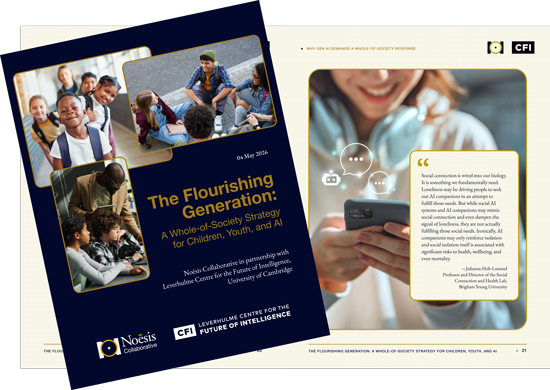
A whitepaper published by Noēsis Collaborative in partnership with the Leverhulme Center for the Future of Intelligence, University of Cambridge



We believe technologies should be tools to enhance, develop, and help integrate a young person’s full range of human capabilities to achieve their aspirational goals in the communities and contexts where they live.”
About this Resource
The purpose of this whitepaper is to address one of the most urgent policy challenges of our time: How should we design policies to advance child and youth well-being in a world of Generative AI?
This new world includes but is not limited to Generative AI (Gen AI) use in toys, gaming, mental health, assistants, social media, and AI companions. This paper is primarily focused on Gen AI that is conversational, human-like in behavior, and social in function, including general-purpose chatbots such as ChatGPT, Claude, and Gemini.
While human development extends into a person’s mid-twenties and growth of human capabilities continues throughout the lifespan, this paper is primarily focused on children and youth from birth to the age of 18, a widely used legal boundary between minors and adults in many jurisdictions. The paper includes:
The risks and potential benefits of Gen AI use by children and youth, grounded in the principle of human flourishing.
Gaps in AI governance that often overlook the developmental needs and rights of children and youth and fail to foster human flourishing.
A design paradigm for developers and builders of AI systems to align their products to the potential benefits and ensure impacts support the full, integral development of human capabilities.
A model policy framework for AI and youth in a whitepaper for policymakers that is able to be adapted to different jurisdictions and contexts. This whitepaper will be used to inform public dialogues and debates about AI and youth policy.
Explore Our Recommendations
-
Policymakers have the responsibility to put the well-being of children and youth as a north star for policy and regulation, aligning legal protections for minors with human development research. To support this responsibility, this paper puts forward a model policy framework with the following three elements:
Gen AI systems should be held to the same rigorous pre-market and post-market safety audits as high-stakes consumer goods like pharmaceuticals, toys, or car seats. These audits should establish that Gen AI products support the healthy development of human capabilities and/or do not degrade a child or youth’s capability development before market access by minors.
Restrict to adults only the use of conversational Gen AI products that mimic a rich human-like inner life (including emotions, internal states, and motivations) and encourages emotional dependence.
Restrict to adults only the use of Social AI that primarily function as companions or are specifically designed, marketed or optimized to form ongoing social or emotional bonds with users.
-
Developed through collaboration with technology companies, researchers across the social and behavioral sciences, and civil society organizations, this whitepaper offers a practical approach for designing AI systems that support the healthy development of children and youth. Grounded in the science and philosophy of human flourishing, it moves beyond risk mitigation alone to provide a positive vision for how AI can strengthen human development. Our guiding design paradigm is simple:
We believe technologies should be tools to enhance, develop, and help integrate a young person’s full range of human capabilities to achieve their aspirational goals in the communities and contexts where they live.
Following from this paradigm, we recommend a set of Design Principles that can embedded throughout the development process, from model architecture and training to product design and deployment:
Protect children and youth from unvetted AI Deployment
Respect the needs and rights of children and adolescents to develop
Parents, caregivers, and youth should have confidence that engagement with these products will advance and not degrade the full range of human capabilities as children and youth develop.
Be honest about the nonhuman nature of chatbots.
Protect human-to-human intimacy and friendships.
-
This whitepaper sets out a recommended ‘whole-of-society’ strategy for collective action for policymakers, industry leaders, researchers, faith communities, civil society organizations, educators, family, and young people to work together to ensure the next generation flourishes in the age of AI. We have organized the strategy around the following priorities:
Mitigate known harms and minimize extreme risks through impact audits, age assurance, and safety by design standards for child and youth-facing Gen AI products.
Invest in independent, longitudinal research, data access, and independent benchmarking of Gen AI’s impact on child and youth flourishing.
Build public and private capacity to monitor, regulate, and respond to emerging harms.
Center the voices of children, youth, and families in AI governance by structuring mechanisms that ensure their input informs product design, evaluation, and regulations.
Equip families and communities with accessible, evidence-based information and clear, plain language disclosures.
Develop positive visions for child and youth interactions with AI by convening multi-stakeholder visioning exercises that center children, youth, and families.

Co-Authors

Ron Ivey
Founder and CEO, Noēsis Collaborative
Research Fellow, Human Flourishing Program, Institute for Quantitative Social Science, Harvard University

Henry Shevlin
Associate Director, Leverhulme Center for the Future of Intelligence, University of Cambridge
Programme Director, Kinds of Intelligence Programme
Contributors, Workshop Participants, and Working Group Members
-

Maria Axente
Founder & CEO, Responsible Intelligence
-

Dean Ball
Senior Fellow, The Foundation for American Innovation
-

Adam Billen
Vice President of Public Policy, Encode
-

Andrew Briggs
Emeritus Professor of Nanomaterials, University of Oxford and Executive Chair, QuantrolOx
-

Ian Marcus Corbin
Founding Director, The Public Culture Project, Harvard University
-

Paddy Crump
Director, FlippGenn
-

John Ehrett
Chief of Staff and Attorney Advisor, U.S. Federal Trade Commission
-
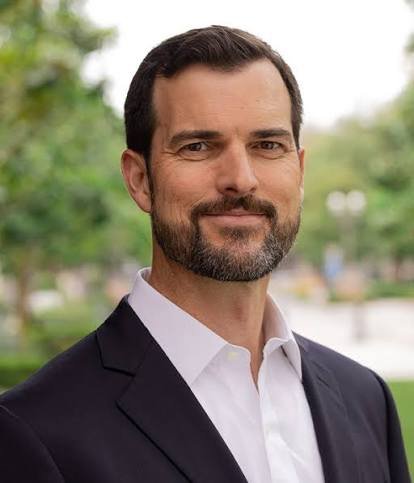
Nathanael Fast
Professor of Management and Executive Director, Neely Center for Ethical Leadership and Decision Making, USC Marshall School of Business; Co-Founder and Co- Director, Psychology of Technology Institute: Design Principles and Practices
-

Amina Fazlullah
Head of Tech Policy Advocacy, Common Sense Media
-

Thao Ha
Associate Professor and Director of the @HEART Lab, ASU
-

Sam Hiner
Executive Director & Co-Founder, Young People’s Alliance
-

Tomasz Hollanek
Assistant Research Professor at the Leverhulme Centre for the Future of Intelligence (LCFI); Affiliated Lecturer in the Department of Computer Science and Technology at the University of Cambridge
-

Julianne Holt-Lunstad
Professor & Director of the Social Connection & Health Lab, BYU
-

Ravi Iyer
Managing Director, USC Neely Center & Psychology of Technology Institute
-

Will Jones
Futures Program Associate, Future of Life Institute
-

Konstantinos Karachalios
Former Managing Director, IEEE Standards Association
-

Martijn Lampert
Co-Founder and Research Director, Glocalities
-

Brad Littlejohn
Director of Programs and Education, American Compass
-

Sonia Livingstone
Professor, Department of Media and Communications, London School of Economics and Political Science
-

Timothy Lomas
Research Scientist, Human Flourishing Program, Harvard University
-

Kim Malfacini
Product Policy Lead, OpenAI
-

Amanda McCroskery
Research Scientist, Applied AI Ethics & Governance Researcher, DeepMind
-

Katie McNerney
Founder and Partner, Leaderfit; Senior Advisor, Noēsis Collaborative
-

Andrew McStay
Director, The Emotional AI Lab and Professor of Technology and Society, Bangor University
-

Amy Orben
Research Professor and Programme Leader at the MRC Cognition and Brain Sciences Unit, University of Cambridge and a Fellow at St. John’s College, University of Cambridge; Lead Digital Mental Health Group
-

Dorian Peters
Assistant Professor in Ethical Design at The University of Cambridge Institute for Technology and Humanity; Senior Research Associate at the Intellectual Forum, Jesus College Cambridge
-

Giada Pistilli
Principle Ethicist, Hugging Face
-

Jenny Radesky
MD Professor of Pediatrics, Division Director, Developmental Behavioral Pediatrics, University of Michigan Medical School; Co-Medical Director, American Association of Pediatrics Center of Excellence in Social Media and Youth Mental Health
-

Jennifer Tacheff
Founder & CEO, Manifest Advisors
-

Felicity Tan
Founding Executive Director, The Risman Foundation
-

Terri Taylor
Strategy Director for Innovation & Discovery, Lumina Foundation
-

Jonathan Teubner
Research Associate, Human Flourishing Program, Harvard University; Program Lead, Flourishing and AI Initiative
-
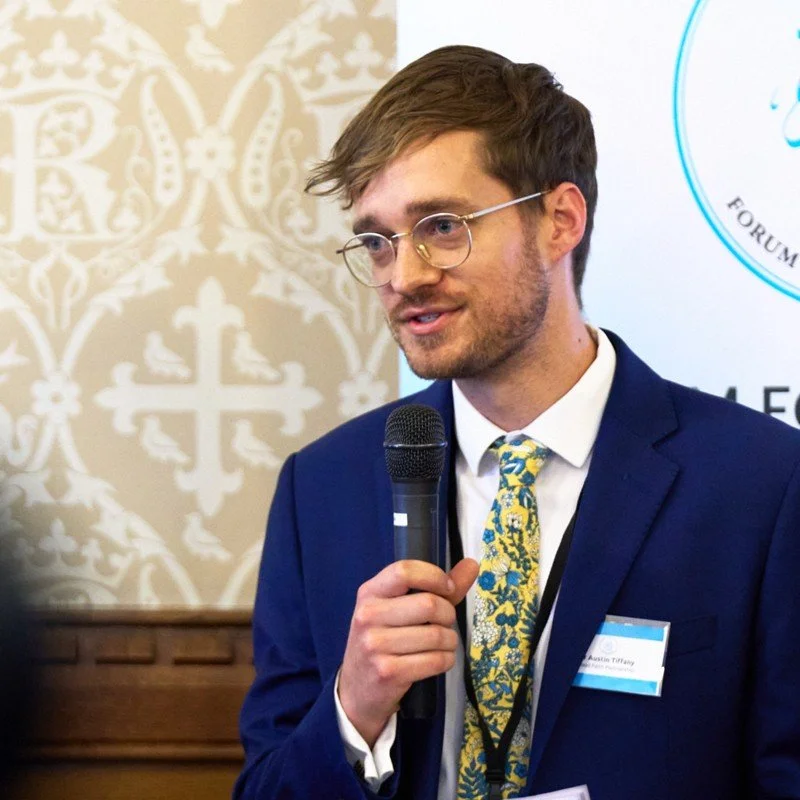
Austin Tiffany
Senior Director, Good Faith Partnership, AI Faith & Civil Society Commission
-

Mick Tobin
Co-Founder & Advocacy Director, Young People’s Alliance
-

David Vasquez
Executive Director, Noēsis Collaborative
-

Angy Watson
Chief People and Tranformation Officer, Paymentology
Launch Event Calendar
We will have live, virtual events coming this fall. Check back for updates!
For questions, media inquiries, or opportunities to collaborate, please contact us at hello@noesiscollaborative.org
© Noesis Collaborative and the Leverhulme Center for the Future of Intelligence, May 2026. All Rights Reserved. Full references and methodology are available in the complete report.
Related Resources


Read our “Social AI and Human Connections: Benefits, Risks, and Social Impact” Whitepaper.

Watch our presentation on Designing AI to Help Children Flourish including recommendations given to the G20.

Check out our AI & Youth Impact information webpage designed for parents.